the installation
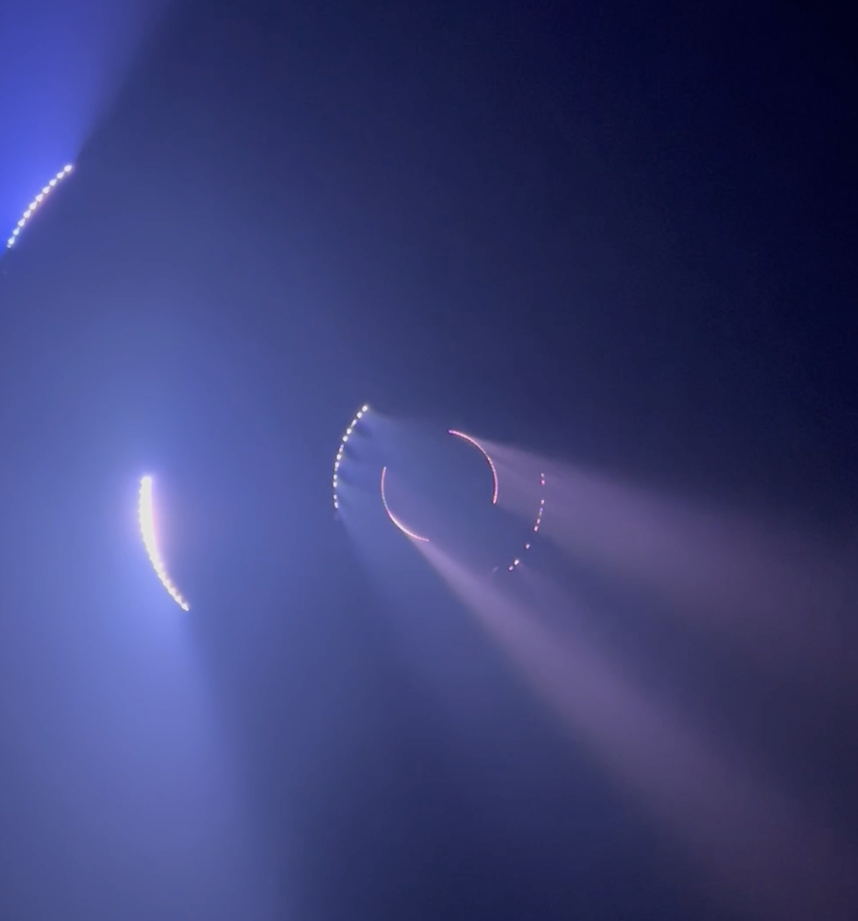
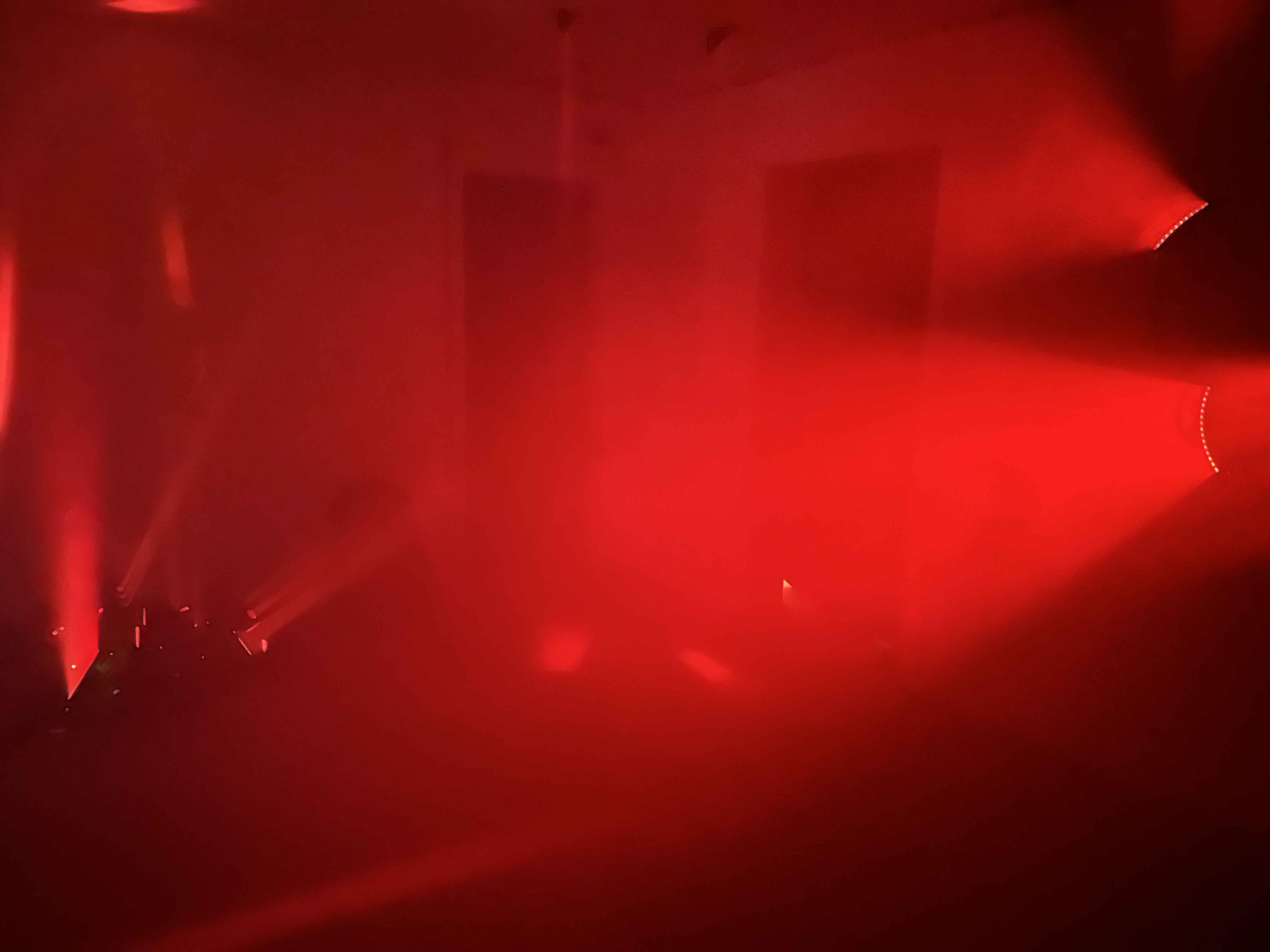
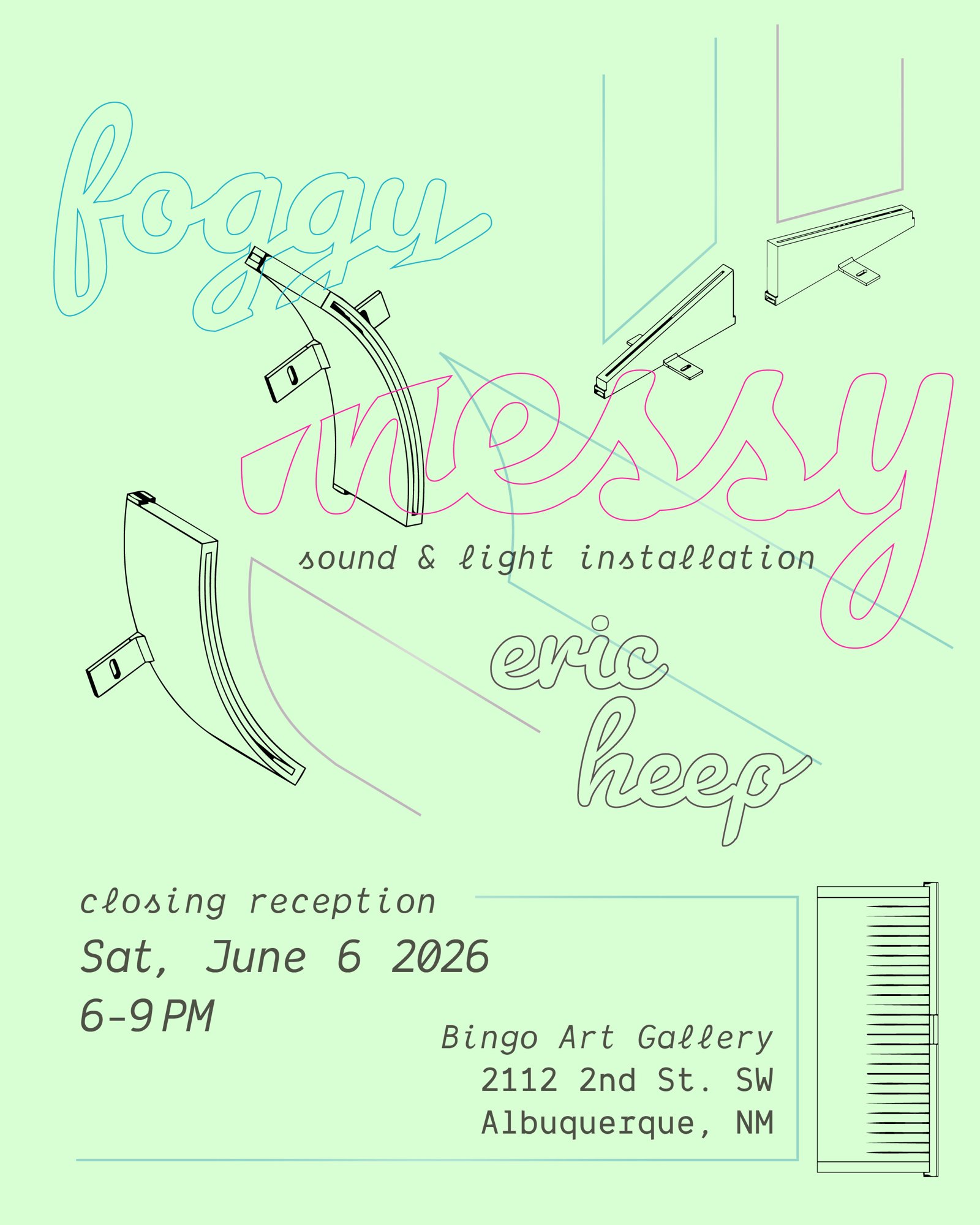
Foggy Messy was a hazy site specific light and sound installation inside of Bingo Gallery in Albuquerque, NM. I suppose you could call this immersive art; the more art I make the less I find genres to fit into. I've been a multi-disciplinary artist for long enough that the phrase "intersection of art and technology" seems off. There's another description out there that hasn't caught on that describes artists who work primarily with technology. Anyway, Foggy Messy is a room you can lose yourself in. I'll describe the intended experience.
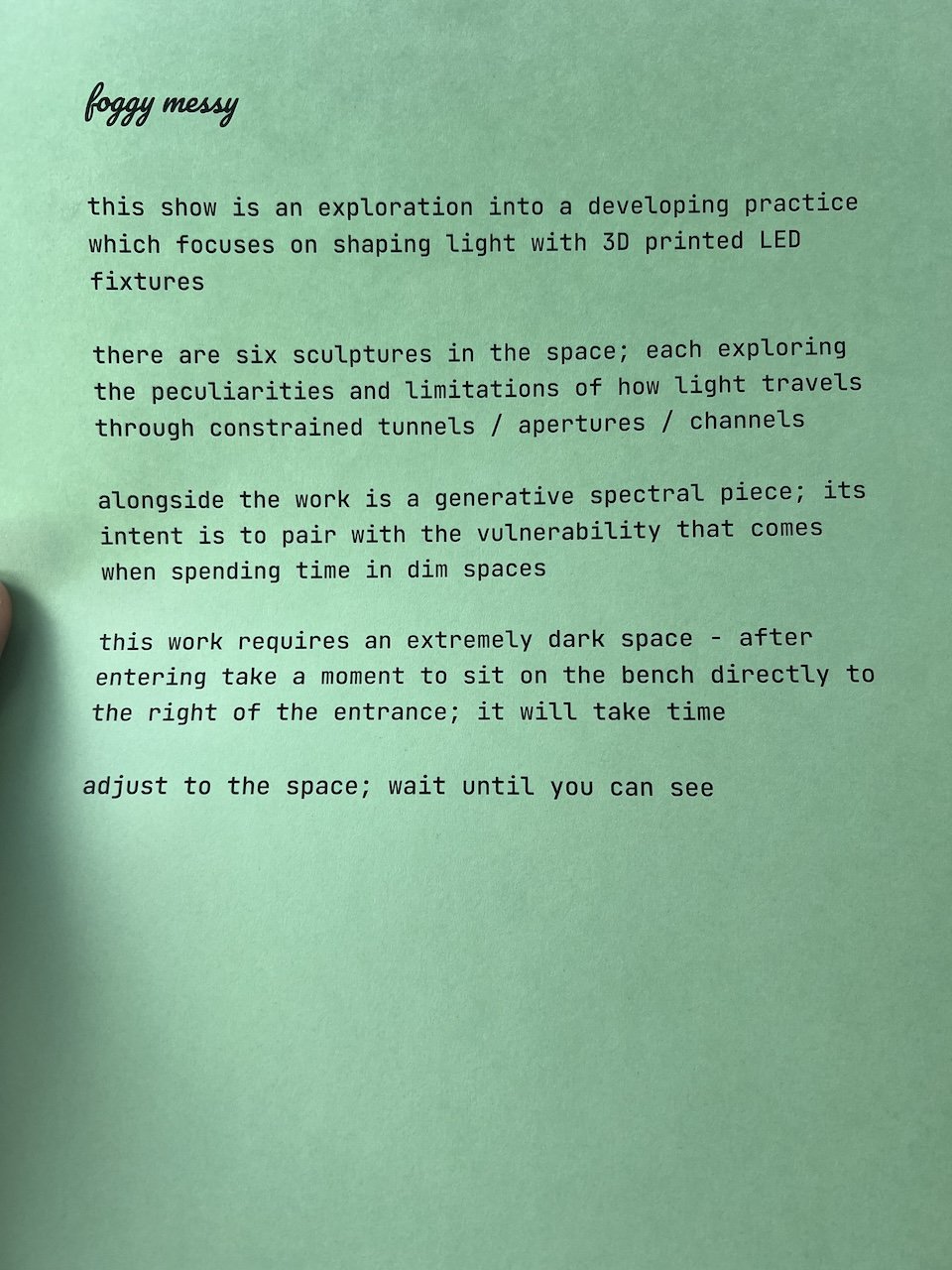
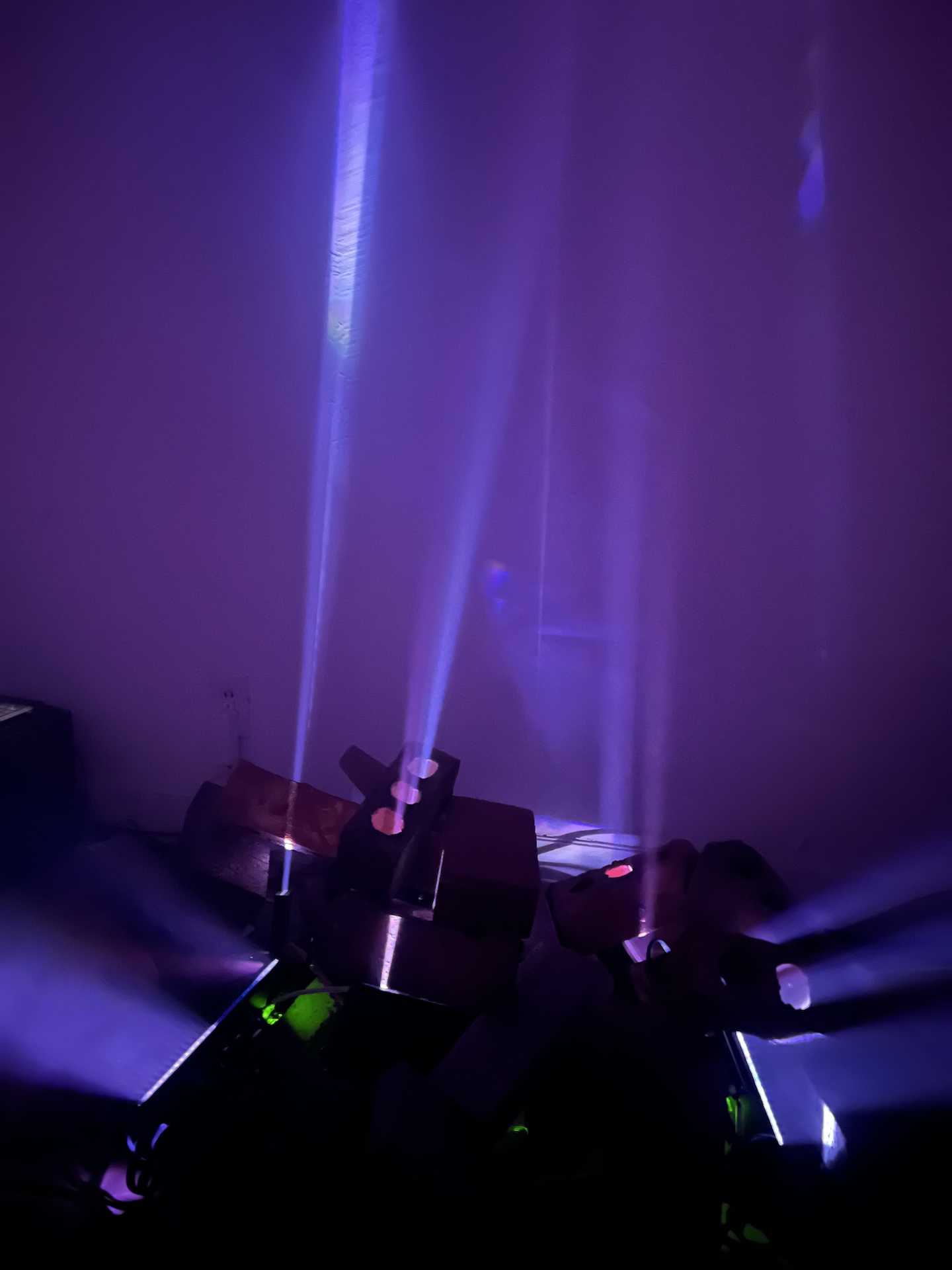
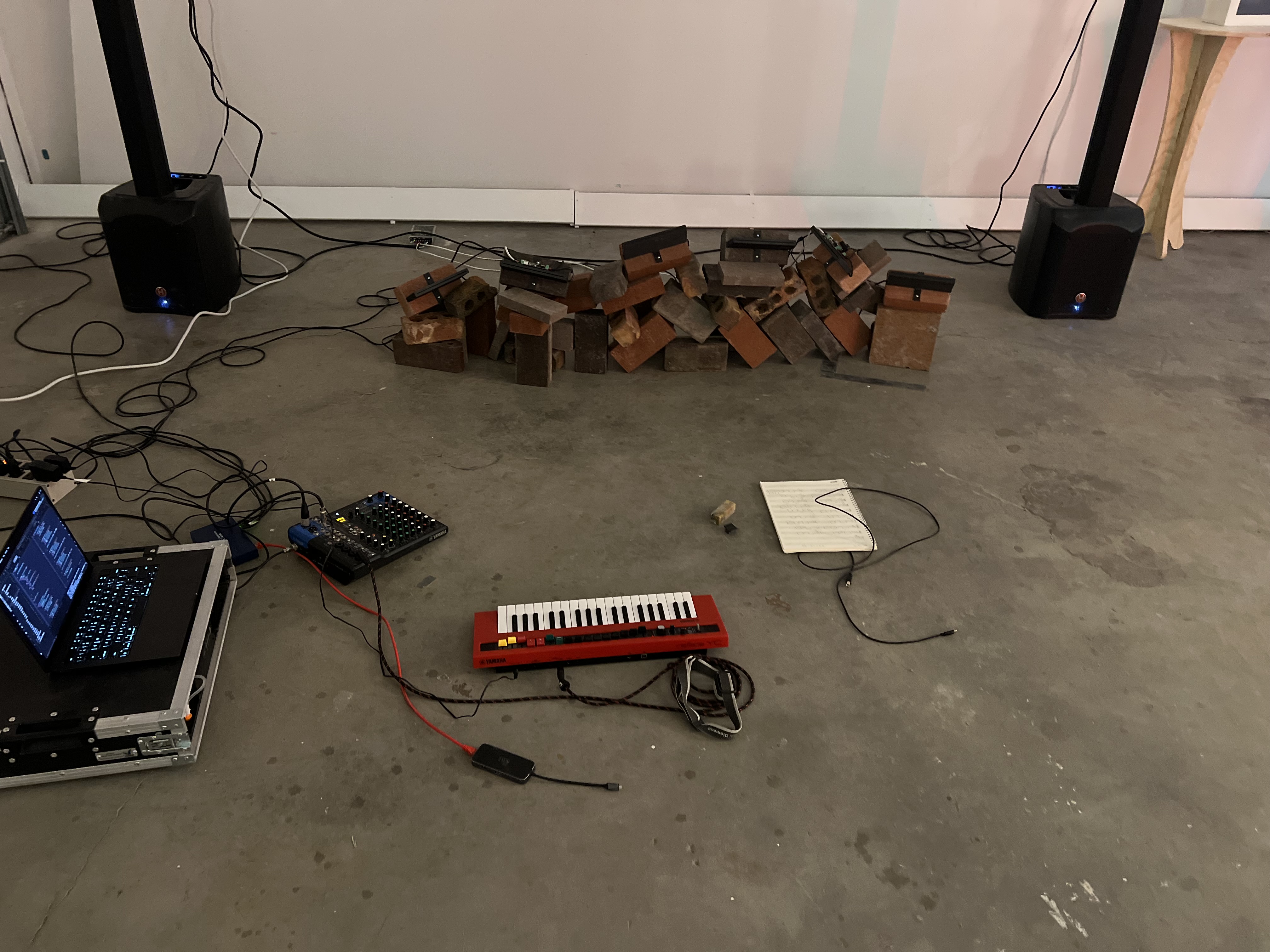
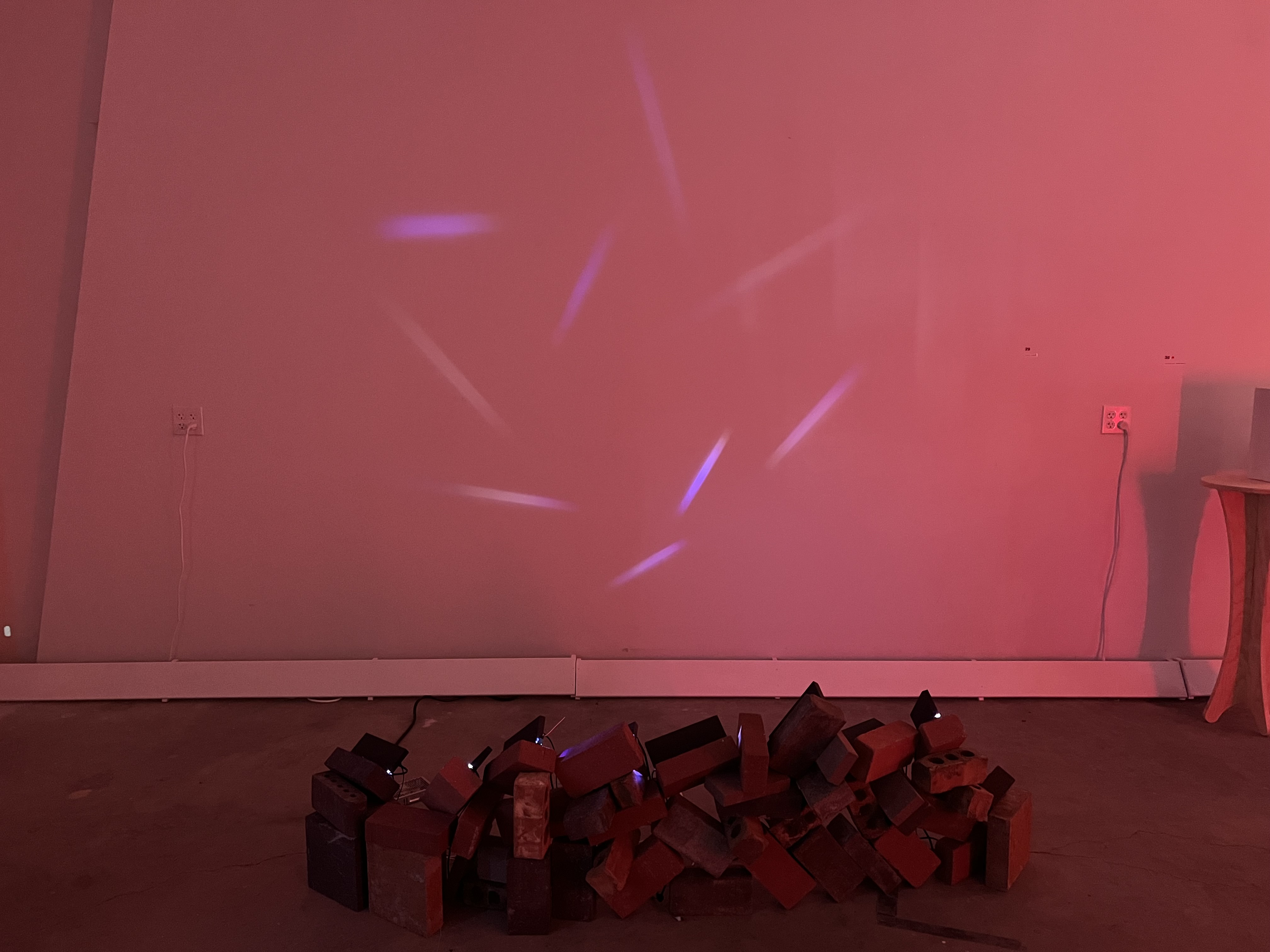
You enter into a very dim space filled with fog. The space is so dark that you have to wait on a nearby bench so that your eyes can adjust to the setting. As you sit, directly in front of you is a circular set of light fixtures shooting beams in your direction. You begin to notice other beams layered across the room that are pulsing to a steady and slow sonic texture. You brave yourself to walk around and notice fixtures of varying shapes. Some are linear, some sinusoidal, but all part of a larger shape. There are fixtures stacked on bricks, fixtures hidden in a pile of bricks, and fixtures attached to the ceiling. The experience is meditative and invites a slowness from you; it invites discovery and self-direction. It's slow and engrossing. A long-form melody starts to become clear as your sense of time shift and you let go of the seconds. The light motions are measured and disparate - they accompany the falling rhythms of the dulcet tones. You sit on the rug in the center of the space and let go.
At least that's what I hope was the experience was like; I never want to be too prescriptive with my work. This work happened in a period of reflection and heartbreak; it's part of series of works that use foggy or messy or spirals in the title. This one describes that moment, post rupture, where the world stops being a bit less intense. You start to calibrate after what you believed was utter devastation. The tones are melancholic, the rhythms are rippling and naturalistic; the space itself requires the guest to offer a vulnerability to allow its effect. I'm wont to delve into these types of moments.
related work
This material for this art is a collision of several ongoing experiments. These past few years I've been experimenting with various ways of shaping light through haze in dim spaces. The first idea came about when working through sketches for an experimental lamp. Juna Skënderi opened a call for artists to contribute to a Santa Fe Lamp Show and this was my pitch. For the opening I wrote a long form piece for organ that controlled the lights in real time. Beams broke through the haze as organ tones melted in the space; it was a good art night for Santa Fe.
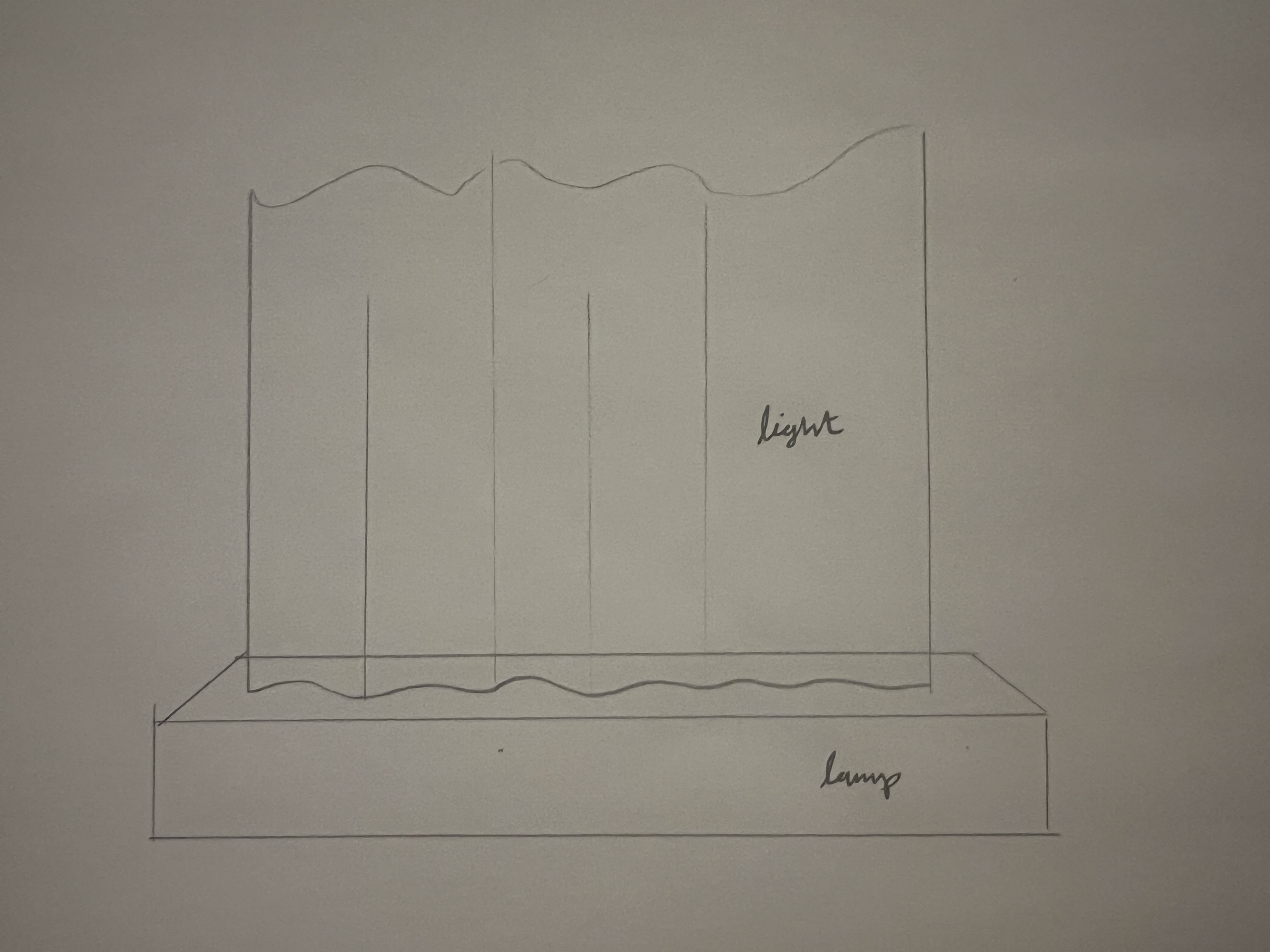
The primary idea behind this method of shaping light requires creating a thin channel for an LED to pass through. By funneling each LED of an LED strip through a a channel, each LED can be directed to leave through it's own aperture.
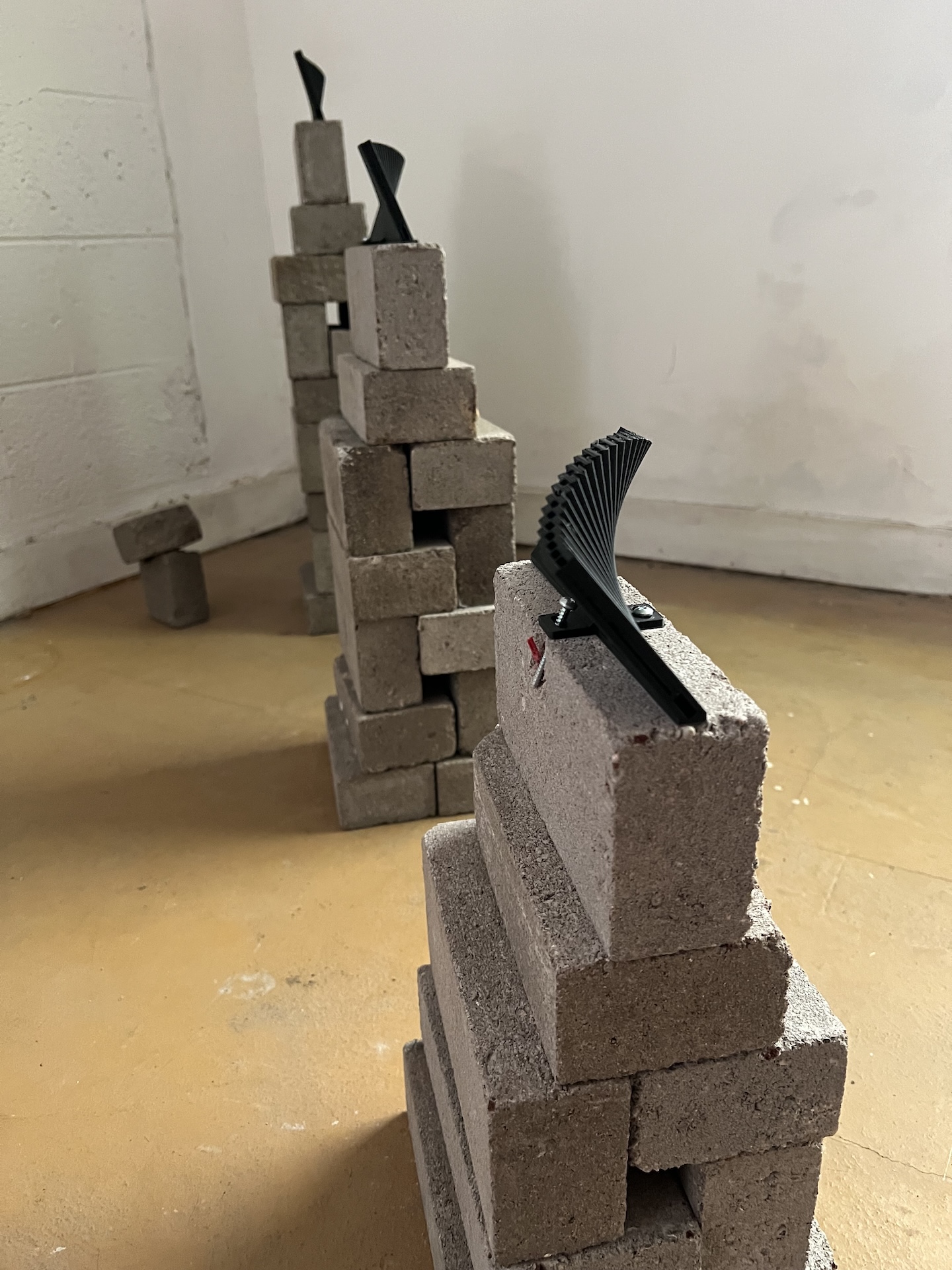
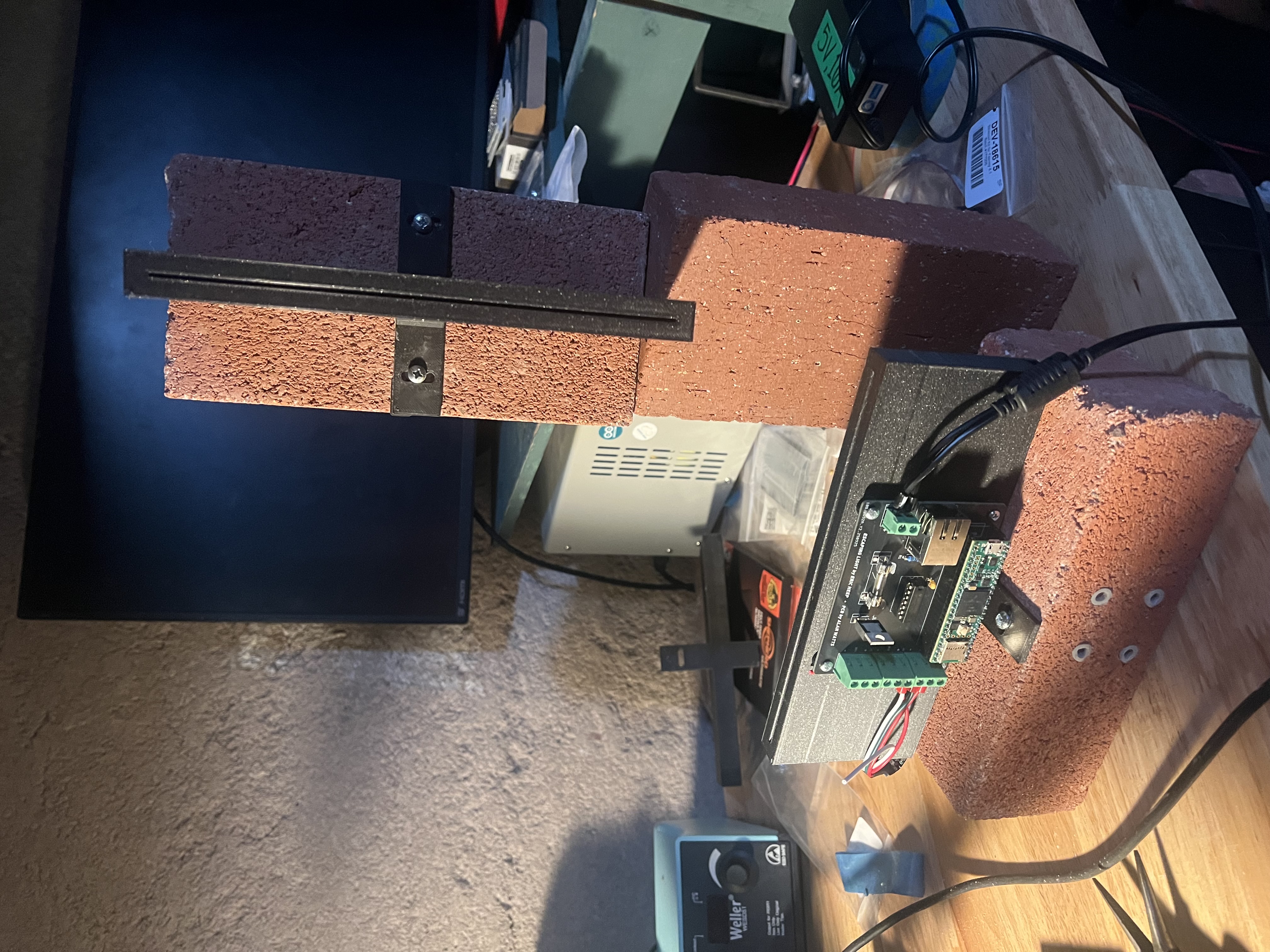
Foggy Messy has six different aperture shapes ~ each is really its own experiment. If I were to continue this project I would want to investigate how to make the LED beams brighter. There might be a lens implementation that could increase the visibility of the beams. Right now this piece is limited by the conditions of the space it is in; it's surprisingly difficult to find spaces that are pitch black.
programming (light & sound)
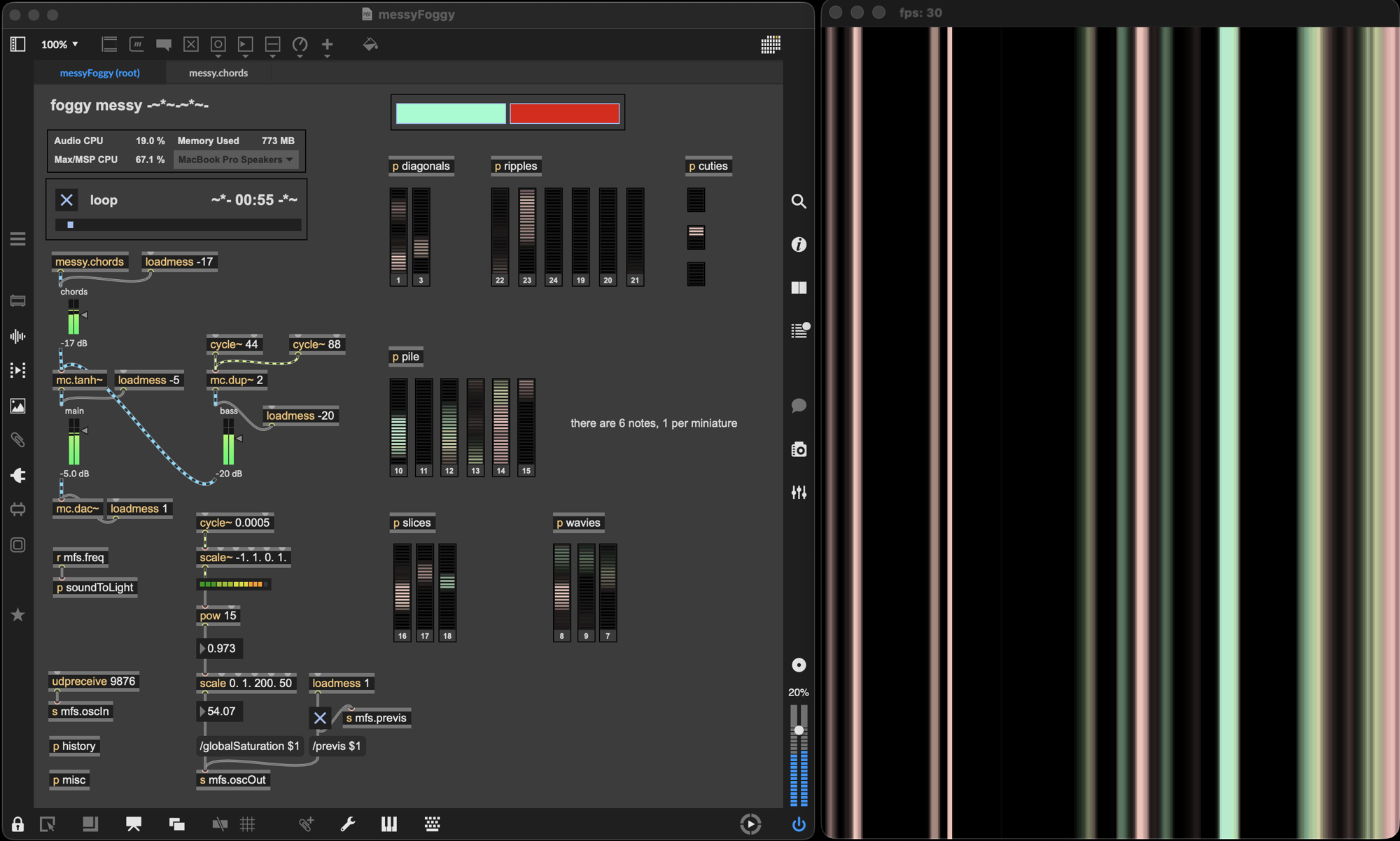
This piece uses Max/MSP for sound and openFrameworks for per-visualization and the LED protocol. I often create systems that send abstracted cues from Max/MSP that are translated in openFrameworks.
The sound is a generative piece of music that uses harmonic series math to move through tuning systems. It loops an 8 note melody over 54 seconds time; repeating with slight variations each cycle. The system uses an openFrameworks application to route Max/MSP OSC events to a custom lighting protocol that is networked to all the fixtures throughout the space.
This tuning of the sound is inspired by a series of Just Intoned Max Patches that I was experimenting with earlier in the year. The original one that I landed on has a much shorter loop.
There is a some interesting synthesis happening here; I have a custom additive synths whose spectral makeup is dependent on the pitches being played. In short, the harmonic series of on additive synth is created by using the difference between the fundamental of the previous note and the current note. This has the effect of blending two complex tones into each other.
There is also some audio rate panning experimentation; its effect is that of a strange amplitude modulator. I heard about this in the work of Drew McDowall and wanted to try my own version of it.
Here is a much too dark video of the piece. It really doesn't do the piece justice and it seems that I am forever doomed to create pieces that resist documentation. I do find that creating this type of work is a form of anti-capitalism; but at the same time I want others to see my work so I have a cause to make more of it. I often make work for myself; but I don't exist in a vacuum.
I want to install this again sometime but with updated fixtures. I could move to WIFI instead of using Ethernet cables and figure out a lens system to increase my brightness. I found the large circular arrangement to be the most effective in the space, but there was such a charm in discovering the small fixtures spread throughout the space. We'll see.